Showing posts with label Dialogue. Show all posts

Saturday, November 18, 2023

What Did You Say?

It's so easy these days to be on autopilot: whether it is driving on the freeway using our car's cruise control; walking across the street as we read our texts and emails; or half-listening to what a Loved One is saying.  Unfortunately, our magnificent brains go largely unused when we don't engage with what is happening around us... like noticing a smile, tear, or the beauty of a sunset -- or -- when we use our smart devices to remind us of what is important and not think of what we may be missing -- or -- when we don't actively analyze the sensory details we take in every moment.

I wonder if that is why we are having so many problems in our world today:  are we on autopilot too often?
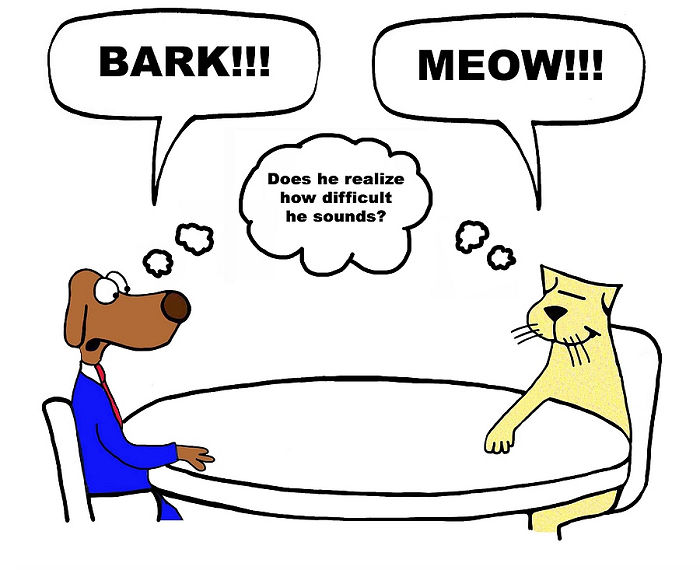
What did you say?
(Photo credit:  Hearing and Understanding are
Two Different Things
, Chatsworth Consulting Group)


Combined with our auto-natures, maybe we have a tendency to believe (incorrectly!) that Assumptions = Facts.  Maybe we need to be reminded that assumptions are merely times when we are filling in the gaps, answering questions without all the information, or jumping to conclusions.  None of these are wrong... but they are not facts!  For instance, when we are on autopilot, maybe we assume we know what really happened.

Think of recent conversations you have had:  when on autopilot...

  • Did you read into... or add meaning... to what was said?
  • How much did you already know... or thought you knew?
  • How many questions did you ask... out of curiosity... to understand more fully what was being said?


How much did you add to what was said?
(Photo credit:  Andy Babitz)


I am fascinated at the origins of some words and how we use them.  For example, people sometimes use conversation and dialogue interchangeably.  Looking at the etymology (the birth and development) of these two words, we see a subtle shift in meaning:

  • Conversation:  Latin origins of the verb "conversari" -- "con" meaning "with" or "together" and "versare" meaning "to turn."  In essence, conversation literally means "turning together."
  • Dialogue:  comes from the Greek words "dia" (through) and "logos" (word or meaning).  Thus, a dialogue is a flow or exchange of meaning.


What percentage do you actually understand?
(Photo credit:  What You Say vs. What They Hear, Annette Segal)

The subtleness of these two words might be in the results of the interaction:  Is the objective to turn together to understand the same conclusion or viewpoint?  Or, is the objective the simplicity of exchanging information?  Underlying both of these modes of communication is the importance of disengaging my auto-tendencies, listening deeply for understanding, and asking questions for clarity and out of curiosity?
 
For me, dialogue is not about convincing you of my value system.  Rather, can we stay in relationship in order to hear what is being said and to try to understand the thinking behind the words being said.
 
What are your thoughts?


Larry Gardepie

(click on link for website)

Saturday, April 30, 2022

Beyond Invitation

You may have heard about, seen or attended a "Beyond" event.... "Beyond Monet" or "Beyond Van Gogh."  It's a wonderful way of introducing and immersing yourself into an artist's life story and artwork.  My brother alerted us to the "Beyond Van Gogh" exhibit in our city.

After going through the entrance, you walk down a series of corridors that briefly introduce you to the history and contribution of this individual.  Eventually, you enter a huge, empty warehouse-sized area... bare, with the exception of a few benches, floor-to-ceiling panels, and walls.  The artist's work is digitally displayed on the panels, walls, and floor, choreographed to music that sets the mood or art theme.

When do you take the time to sit and notice?
(Photo:  Beyond Van Gogh, entryway to exhibit,
Larry Gardepie)

 
Several thoughts came to mind as I sat on various benches or walked around the room:
  • The invitation to sit and notice;
  • The ability to bring artwork alive through motion and music; and,
  • How much I don't know!

As the themes changed, the colors and textures of the walls and floor seemed to melt and transform:  from warm and cooling colors to vibrant splashes of life; from earthy country scenes to faces of farm workers; from city buildings to starry nights.  The Light of Life captured and reflected Van Gogh's interpretation of life, what he saw and experienced.


What do you know about a Loved One?
(Photo: Beyond Van Gogh, projected artwork,
Larry Gardepie)

Many galleries and museums gather and display artwork.  I've seldom wanted to stay and learn more at these galleries.  There was something different about this exhibit:  the ability to Go Beyond.  Though dying fairly unknown and poor, Van Gogh's contributions to art and his letters to his brother live on and are re-imagined... beyond the 37 years that he graced our world.

I wonder what captures our attention:

  • Is it an invitation to sit and notice?
  • Is it new ways of presenting information?
  • Is it the humility to accept what we don't know?

Are you willing to sit and listen?
(Photo: Beyond Van Gogh, Immersed in His Artwork,
Larry Gardepie)

 
In a similar way, I wonder about our invitation to dialogue with each person we meet:  Do we take the time to notice, to sit, and to listen?  What information do we present and in what form do we offer the information?  Are we willing to accept that there are areas we haven't experienced or that we just don't know the answer?  Are we willing to stay and linger - to ask and to learn?
 
The invitation this week is to go beyond what we assume, what we think, and what we know or don't know.

Larry Gardepie

(click on link for website)

Saturday, April 16, 2022

A Heart That Listens

Have you heard the phrase "Beauty is in the eye of the beholder"?  Recently, I read  that this saying first appeared in Greek in the 3rd century BC.  The saying did not surface in English in its current form until the 19th century.  There were similar versions as people over the centuries attempted to explain the subjective nature of what we like or don't like.

I wonder:  does Beauty Exist... whether we see it or not... and we have the personal choice to experience it or not?

Are we able to see beauty?
(Photo credit:  Michael Tompkins)


In other words, our seeing and accepting Beauty does not negate its existence.  Rather, our personal and individual choices filter the world:  we accept only a portion of the beauty that exists; there is so much more than what we hold in our limited and time-focused minds.

If this is true about Beauty, is it the same for Truth and Kindness and Goodness?  They exist, but our minds pass over what we do not understand.  Our finite lives experience what we are able to in that Moment of Choice.

Does beauty exist if we don't see it?
(Photo: Sunset at Sea, Larry Gardepie)


Dialogue is one tool that allows us to ask questions, to seek understanding, and to touch briefly another person's world... a world of Truth and Beauty that already existed even before our questions and understanding.  The passing over and resurrecting The Choice to see beauty invites us into opportunities to reconnect with family and friends.  The ability to Be Kind and Listen is the salve that heals our blindness to the Beauty, Truth, and Goodness that already existed in those around us.

When can your kindness heal the hearts of others?
(Quote attributed to:  F. Scott Fitzgerald)


May these Holy Days of Passover, Ramadan and Easter open our minds and eyes to the Holy One that exists in you and your families.

Blessings as faith stories are remembered and dialogue enkindles what is important. 
 

Larry Gardepie

(click on link for website)

Saturday, March 5, 2022

Questions Divided: Individual or Together?

Standing on the balcony of our stateroom, I watched the pilot boat inch closer and closer to our ship ready to offload the person who would guide us into port.  How interesting, I thought, as I caught the reflection of the pilot boat in the balcony's glass siding.  Knowing where I stood and the direction we were going, I knew which boat was real and which was the reflection.

But, I wondered, is life as simple?

  • How do we know what is real or based in facts and what is a reflection of our thoughts, opinions, or projections?
  • Are we willing to have a pilot -- a friend, a mentor, a spiritual director -- guide us into a port of broader understanding?


How do you determine what is true?
(Photo: Pilot Boat Reflection, Larry Gardepie)


The idea of reality and opinion -- fact and reflection -- continued over the next few days of our journey.  Entering an elevator one day, I noticed that two of us were standing on the daily floor mat:  today was Thursday, the mat stated.  I wondered if we could agree on this fact?

One day the floor mats had been changed out of all elevators... except one: that elevator had been off-line the previous day and the floor mat had not been changed -- it was the previous day's mat.  I wondered if people entering that one elevator would catch what happened... or would they carry that incorrect day with them, trying to convince others?

When can you stand on common ground?
(Photo: Elevator Floor Mat, Larry Gardepie)


How can we reach common ground in our knowledge, the information we receive, and our understanding of what we have learned?  It seems that questions like this can either divide us further or bring us together.

For me, the emphasis is on the relationship:

  • Do we want to stay in relationship with the other person?
  • Are we interested in or curious about the knowledge and facts they have gathered along their life's journey?
  • Can we ask questions that suspend our need to be right or prove the other person wrong?

Are you able to see the beauty in the moment?
(Photo:  Fiery Sunset at Sea, Larry Gardepie)


What I love about being on the ocean is the interplay between water and air, ocean and sky.  On clear days, cobalt ocean waters reflect the deep blue of the sky; on cloudy days, the waters are dark, grey and sometimes turbulent when it is windy.  What is awe-inspiring is the moment when the dark, cloudy days suddenly burst open with clouds on fire reflecting the relationship of sun, water and light.
 
Staying in relationship and working towards that moment of understanding is what dialogue is about.  Our discussions may not be as fiery as a sunset, but the ability to step back and notice what is happening is what is important.

This week, may we:
  • Distinguish between fact and reflection;
  • Question what we don't know or haven't experienced; and,
  • Seek guidance when we don't understand.
 

Larry Gardepie

(click on link for website)

Saturday, January 22, 2022

Dinner, Death and Dialogue

"Now, how did you get there?" a friend sometimes asks me as we talk.  We might start on one topic and suddenly I'll be talking about something not outwardly connected!  Let me give an example.

My mind was preoccupied with the Wolf Moon throughout the day.  The local news had been talking it up for several days, but when that evening arrived, our city was covered with clouds and a possibility of rain.  I was thinking about not seeing the Wolf Moon as a friend and I had dinner at a Japanese restaurant.  My earlier reflections centered on an individual hope, a small moment in time to watch this one moon rise.

Then I noticed the Japanese lanterns, moon-like in their appearance, all shedding light on our outdoor dining area.  My mind refocused on the moment at hand: dinner with a friend; the ability to share our time together, shedding light on each other's thoughts and experiences.

When do you recognize another person's light?
(Photo:  Japanese Lanterns, Larry Gardepie)

Later that evening, June - a friend from North Carolina, sent a photo of the Wolf Moon illuminating the snow-covered landscape around her property.  We met June and Buz, her husband, on a tour several years ago.  Observing how they communicated, watched over, and took care of one another other, were sacred moments.  On our last evening together, June and Buz shared how their faith and love guided them.  June's comment about the photo was so true to her:  "Give God the credit for the night light."

Knowing that Buz had died recently, I wondered about the individual night lights that shine in our darkest moments.

Does your life reflect what is important?
(Photo:  Wolf Moon over snow-covered field,
June Buzzard, January 17 2022)

Recalling the days and months after my parents died, I recollected feelings of loss and separation, the thoughts left unshared, and the path ahead without them.  How do we see ourselves without the other?  Our love and faith are tested as we re-member, re-define, and re-connect with what is important: those night lights we nurtured when all was well.

Is that what is happening with the music group Il Divo right now?  Four talented individuals were brought together to combine their talents.  After entertaining millions of people for almost two decades, Carlos Marín unexpectedly died of COVID last month.  Are they still Il Divo without Carlos?

What happens when someone leaves you?
(Photo credit:  Il Divo, The Promise)


I can hear my friend asking at this point, "How did you get there?"!!  I moved from an individual thought (wanting to see the Wolf Moon and June's photo) to shared experiences (Japanese lanterns; dinner with a friend; observing June and Buz) to wondering about the loss of a loved one (Buz; my parents; Carlos).

My friend's question is valid... as are my interconnected thoughts.  Our willingness to share our thought processes with others -- June and Buz' faith and love; the God-inspired night lights of our lives; the experience of loss and separation -- is what dialogue is about.  Sharing with another "how we got there" is the movement from individual to common-unity.

Are you willing to explain your thought processes to another person this week?

Larry Gardepie

(click on link for website)


Saturday, January 15, 2022

The Power of Waiting

It is fitting to celebrate Betty White on her 100th birthday (January 17).  Her life's work is on display through TV reruns, YouTube recordings, books, and charity work.  People marvel at her longevity -- age, a career spanning 8 decades, and her positive focus on life.  In If You Ask Me, she describes how her comedic timing developed:

"I'd be sitting there as a kid, wanting to add to the conversation, wanting to jump right in with an idea, but if I blurted something out it might ruin the moment.  It taught me a lot about the power of waiting." 

Several images came to mind when I read this:

  • Standing around a Vancouver's Gastown steam clock waiting for something to happen
  • Sitting in the hospital during a loved one's surgery
  • Listening to a friend's recent challenges

Are you willing to wait?
(Photo:  Gastown Steam Clock, Vancouver - Larry Gardepie)


I also thought back on the dialogue, mentoring, and mediation trainings I have participated in.  Each focused on the importance of listening... and waiting for a question to arise.  Through these trainings I realized how I am conditioned to give my perspective:  I am impatiently waiting for you to finish talking so that I can tell you about me!
 
The power of waiting allows us to slow down our responses, consider what we have heard, and allow a different interaction to occur:
  • What did you mean by...?
  • Tell me more.
  • Help me to understand.

What is your perspective on...?
(Photo: San Francisco Mission District Murals - Larry Gardepie)


Waiting does not mean that we are disengaged.  It
doesn't mean that we agree with another person's conclusions or decisions.  Rather, our role is to listen for connection and understanding; our responsibility is to respect and accept the similarities and differences.  We try to understand the conclusions and decisions by checking out the reasoning or experiences that influenced those endpoints.
 
The process of waiting gives us time to connect within ourselves as well:
  • Why am I reacting so strongly to what is being said?
  • Am I being challenged to reconsider my own values and experiences?
  • What does this say about me -- in relationship with the person who is speaking?

What risks are you willing to take?
(Photo: Cliff Walk, Capilano Suspension
Bridge Park, Vancouver
- Larry Gardepie)


Waiting is like crossing a bridge, taking a risk that something important is on the other side.  It means setting aside the comfort attached to our own thoughts and conclusions and inviting curiosity:  What divides us?  What can bring us together?  How can we learn to trust again?

Like Betty, may we learn the power of waiting, and may we take the risk to see the world through lenses of humor, caring, and love.
 

Larry Gardepie

(click on link for website)

Saturday, December 18, 2021

The Ups and Downs of Language

Language has always fascinated me:  humanity's desire to label objects and thoughts -- often abstract ideas -- to communicate with others.  I have often wondered:  Who came up with that word?  Why is that object named...?  How is it possible that we understand one another?

I am also intrigued by people who study the origin and history of words (etymologists).  Being able to listen to a word and know what words have the same roots (like author and authority or expert and experience), and which languages influenced the development of these words... all in the interest of communicating, connecting, and conveying ideas as our knowledge expanded.

Sometimes I am aware of being on autopilot, though, when speaking to some people:  rather than approaching each encounter as a sacred event of Connection and Creation, I often experience only hot air (emptiness, exaggeration, or pretentiousness).

What effort do you make in the words you choose?


The ups and downs of our communication are further complicated by the foreign languages that we speak: our natural or native tongue from our family upbringing might be misunderstood when traveling beyond our familial boundaries.

A friend of mine served two years in Turkey with the Peace Corps.  He has many stories of teaching English and learning Turkish.  As he was sharing with me simple words like Yes (Evet) and No (Hayir), I noticed my mind recalling a hot air balloon trip I took many years ago.  The pilot would ask if we wanted to go higher.  For me, it would have been easy to respond to this English question with a Yes or No.  I wondered what the pilot would have done if a Turkish passenger had said Hayir (which, in English, sounds like higher... but in Turkish means no)?!

Can you rise above disagreements
and misunderstandings?

As we experience the ups and downs of language, I wonder if we take the time to:

  • Clarify what we have heard;
  • Share our understanding of what was said or what we interpreted; and
  • Be willing to adjust our knee-jerk reactions or thought-out responses to the new information shared?

After all, you might be having a good time and wanting to go to the next level whereas my experience might be the opposite:  I might need the situation to gently slow down, get to ground level, before I can move on.  Being on autopilot risks our ability to navigate the currents that direct where our relationships go.

How might we navigate the currents
of different languages and ideas?


The wonder of hot air ballooning is the realization of how quiet it is to float above the noise and chaos on the ground.  When the fire burner is not heating the air, silence and tranquility settles in.  But, as the balloon floats over populated areas, the balloon focuses and amplifies the sounds below:  it is easy to hear a person talking hundreds of feet below!
 
A lesson in communication and dialogue:  the ability to float above the noise and confusion AND to focus on what is being said!
 
May we learn to center our attention this week on the words people choose.  May we listen to what is being shared and not shared.  May we seek to amplify a sense of understanding.
 

Larry Gardepie

(click on link for website)

Saturday, December 4, 2021

Building Perspectives

Downtown San Diego is going through another transformation: a section of North Harbor Drive has become an eight-block construction zone.  Seven major buildings are in various stages of development: the WWII-era Naval Supply Depot was demolished, giving way to a sleek 17-story NAVSUP Fleet Logistics Center San Diego, a research and development district (RaDD), and a bayside park.  Over the next decade Seaport Village will be replaced by shops, hotels, a hostel, an aquarium, and an observation tower.

I have mixed feelings about this new growth: excitement and wonder watching earth being moved and foundations laid; sorrow and loss watching the past being torn down.

What foundations are you laying for the future?
(Photo: RaDD, San Diego)

As I sit with these competing emotions, I have been reflecting on life in general:

  • How often do I hold onto past constructs and beliefs?
  • What causes me to eventually accept new ideas and insights?
  • Is there a way to honor both old and new as life changes?

Life provides many experiences where foundations are shaken or strengthened.  How do I adapt and stay relevant in our emerging world?

When do you work together for the common good?
(Photo:  RaDD, San Diego)


Standing in a safe viewing zone surrounded by various stages of development, I observe dirt being moved, surveyors marking the site, foundations being laid, and workers coordinating their activities around common tasks.  Human ingenuity and cooperation envision skyscrapers rising from these holes.
 
Years of planning, discussion, lawsuits and decisions brought about this day where people can work together to move from past to future.

Can you see new horizons rising?
(Photo: RaDD, San Diego)


Aren't relationships and dialogue like that:
  • Moving from the past to the present, laying foundations for the future?
  • Listening, agreeing, disagreeing, and arriving at common understandings?
  •  Eventually working together to rebuild ways to rise above the holes in our individual characters?
As we move through these final days of 2021, I wonder what must be removed to create space for 2022?  Where can we imagine ways to work together?  How might we hold lightly the past and present as we adapt to a common future?

May we seek perspectives and horizons to help us rise above our pasts!
 

Larry Gardepie

(click on link for website)

Saturday, October 30, 2021

Celebrating Life's Lessons

By now, I am sure that many of us have participated in a virtual meeting or an online gathering.  Zoom, What's App, MS Teams, FreeConferenceCall and FaceTime became household names when the pandemic began almost two years ago:  people needed ways to physically distance and yet stay connected.  Remote work and online learning suddenly became the norm as we were inserted into  "Brady Bunch" grids on our computer monitors.

I wonder, though:

  • Was life any different than before the pandemic?
  • Weren't we already skilled at boxing people in and keeping others at a distance?
 

How do you stay connected?
(Photo credit:  Brady Bunch, Wikipedia)


I was reflecting on these questions after participating in a friend's 80th birthday celebration this past week.  His wife had arranged a Zoom session where we could gather to share stories, participate in a trivia contest about Jim's life, and offer well wishes to our friend, loved one, and colleague.

Jim served at my church when I was in school.  Over the years he would guide me as a mentor and spiritual director.  We have stayed in touch through Christmas cards, emails, and virtual reunions.  Isn't it amazing when we have people in our lives who watch out, listen to, and challenge us?

What have you learned from others?
(Photo credit:  What Happens When Young
and Old Connect, Greater Good Magazine
)


Celebration of Life, for me, has occurred when I begin to recognize the different boxes I have created... for self-protection; safe-keeping of treasures; or to define and limit myself and others.  A box is still a box whether I store memories or create expectations.

What I have learned from Jim and others is the importance of: (1) recognizing the human tendency to understand life by defining and labeling; and (2) letting go of these restrictions we place on life.

In other words, celebrating life is the act of being in the present and accepting the person who is before us:  the person I am right now and the gift I encounter in you.

When do you celebrate life's lessons?
(Photo credit:  Young Helping the Elderly)

As we walk together, it is the reciprocal actions of giving and receiving, guiding and learning, offering and accepting that allows us to acknowledge the gifts of Self and Other.  Knowing that I don't have to be perfect releases me from one boxed-image of myself.  Understanding that I don't have all the answers opens another box.  Hearing, appreciating, and accepting truths you have learned frees me from a binary framework of Right-Wrong, Yes-No, and Truth-Untruth.

Jim described us as Pilgrim People: journeying together -- sometimes leading, sometimes following, and sometimes carrying one another.  Whether physically distanced and remotely connected or being in the same room, the invitation is to reach out, open the boxes that surround us, and celebrate the gifts we discover.

What do you celebrate today?  What lessons have you learned and are willing to share?

Happy 80th Birthday, Jim!  And Happy 6th Anniversary of this blog!

Larry Gardepie

(click on link for website)

Saturday, October 23, 2021

Caution Eroding

Walking along the cliffs and tide pools of the Cabrillo National Monument I was taken by the beauty of the rugged coastline.  The rhythm of the waves rolling towards and crashing against the cliffs was mesmerizing.

Signs along the way explained how rain and runoff created layers of sediment on the ocean floor.  Over millennia the sediment hardened to rock and seismic activity thrust the ocean-layered floor above waterline to create this fragile coast.  The waves carved out what is seen today.

Layers of build-up over the years eroded away to create the beauty of this day.

What are you seeing or experiencing today?
(Photo: California shoreline, Cabrillo National Monument)


As I continued to watch the waves break against the shoreline, I realized that the action of carving away continues with each undulation.  What I saw or experienced a moment ago is not the same as it is now.  Each wave brings change:  change unknown in the previous moment.  The first image is but a memory:  the second image is different and beautiful in its own way.  I needed to let go of what I have seen (past) and focus on what is changing (now).

In other words, how will the next wave create or alter what I am seeing?

Can I let go of the past
to see what is happening now?


As I read the information signs and watched the continuing revelation of God's creative touch, I pulled back from the apparent beauty and noticed other signs, pylons, and barriers that warned of the unstable nature of the shoreline as the water undercut the cliffs' base.

It was interesting -- and a little disheartening -- watching people ignore the warning signs and walk beyond the barriers: wanting to sit on the cliff's edge; needing to take a selfie against the dangerous backdrop; walking along the fragile surface that had evident cracks where rock would eventually tumble into the ocean.

How do we respond to
the warning signs in our lives?
(Can you see the warning pylons at the cliff's edge?)


How easy it is to ignore the warning signs that sediment and erosion creates in our lives:  the lies that unfold; the truths untold; the fragile natures of our relationships when we no longer trust.  Do we ignore the layers of buildup over the years?  Are we afraid to acknowledge that the sediment in our lives needs to be removed?

What causes us to not pay attention to the warning signs in our lives:

  • Misunderstanding what another person says... and not asking questions?
  • Seeing looks of frustration or anger... and not checking in?
  • Mistrusting other people's intentions or motives... and not caring?

Walking along the cliffs of my life, I oftentimes am taken in by moments that attract or distract me.  I don't always pull back and notice the barriers or signs that alert me to other views.

I am wondering:  What do you focus on?  How do you respond to warnings?  Is there a way to balance misunderstandings and mistrust with a wider view of truth and beauty?

Larry Gardepie

(click on link for website)

Saturday, October 2, 2021

Stepping Stones to Understanding

Working with a local non-profit, I have been asked to develop a process to address the systemic changes and restructuring they are experiencing.  The CEO mentioned several times that he wanted Stepping Stones to show what might be done at various stages of their reorganization.  Familiar with my dialogue studies of the past seven years, I am aware that any change brings about low awareness.

Just think about changes you have experienced.  There were probably periods of uncertainty and  doubt.  There may have been times when people blamed others.  Not understanding what was happening, We begin to talk about They... the Others causing the problems or asking us to change.  We may have become reactive, mistrusted other people's motives, and became self-absorbed.

What is the first step we could have taken?

What steps do you take to understand change?


The first step for me is Noticing: the act of perceiving, becoming aware, and paying attention.

Noticing creates a Pause that allows questions to surface about the calm or turbulent moments in my life:

  • What am I afraid of in this moment?
  • Am I open to learning something new about myself and others?
  • Am I willing to listen in order to understand?
  • Who has information that needs to be shared?

How do you stay focused when journeying
between calm and turbulent times in your life?
 

It seems that Willingness is a key step for me: the inclination or readiness to  do something.  Noticing-Pausing-Willingness are tied together, beginning a journey across the divide that separates me from others.
 
If you've ever crossed a river using the stones scattered across its surface, you sometimes slip or fall into the river.  You learn that some steps are wobbly and need to be approached with caution; other stones are more stable and are easier to use.  Our stepping stones to understanding are similar: as we become more aware, we notice which steps we don't feel comfortable with -- possibly because we haven't practiced that skill or the situation is new to us.
 
The next steps we need to take?

How might you cross the waters
that divide?

When I am uncomfortable with my skill set, I have learned two other steps:  naming the fact that I Need Help and Asking for Help.  These are two very vulnerable and humbling steps!  By recognizing that I Don't Have All the Answers (another step), I find myself more open to Listening and Learning.
 
The project I am working on for the non-profit CEO, defining the stepping stones to change, seems similar to the stepping stones of understanding:

Open to Listening and Learning
I Don't Have All the Answers
Asking for Help
I Need Help
Willingness
Pausing
Noticing
 

What steps help you to understand?
 

Larry Gardepie

(click on link for website)